While the New Museum Goes Dark, Freeman Alley Stays Open Late
September 10, 2026
September 10, 2026
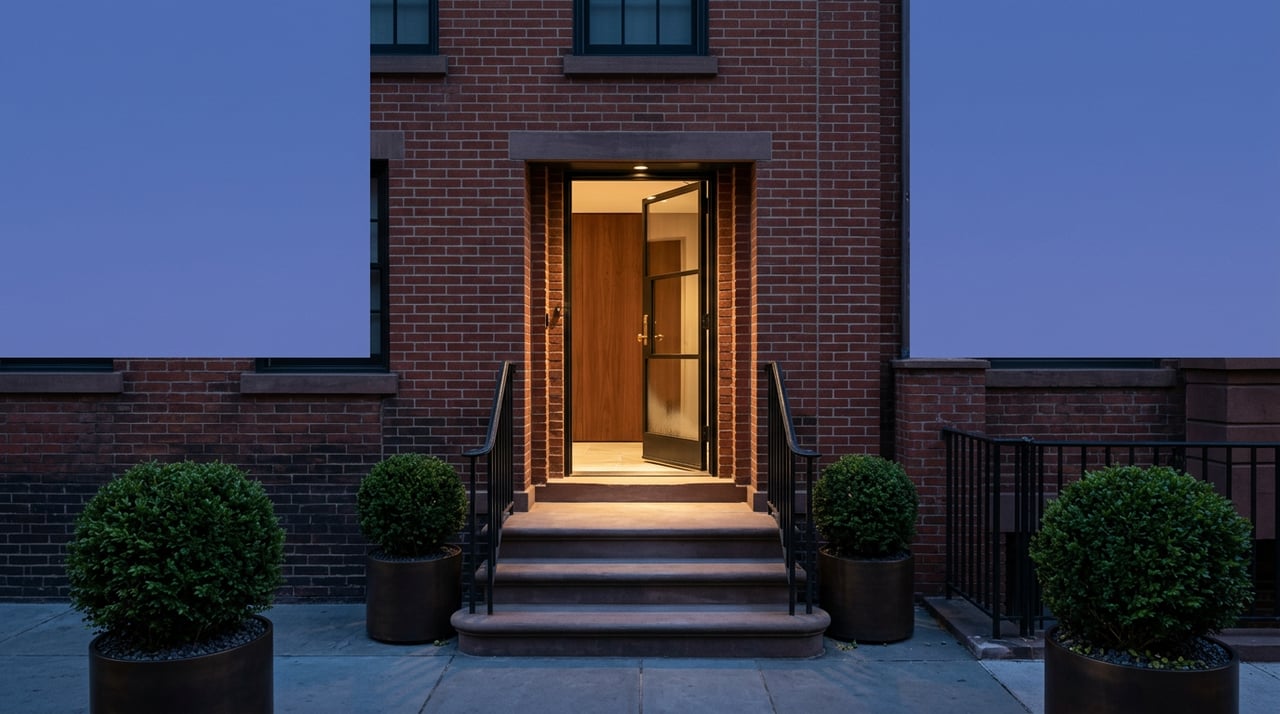
Walk down Freeman Alley on a Tuesday night this month and you will notice something the museum crowd never sees. The lights are off overhead. No line for the elevator, no wall text, no docent group blocking the stairwell. But at the end of the alley, past decades of layered graffiti, a cork-lined dining room is running full service until one in the morning.
The alley sits on the Bowery, on the block where SoHo's eastern edge gives way to Nolita, close enough to walk from either direction without checking a map. The New Museum that backs onto it closed its doors on August 31 for an exhibition changeover and will not reopen to the public until September 24. That is a three-week stretch with no galleries, no admission line, none of the foot traffic that usually spills out of 235 Bowery and down toward Freeman Alley. And yet Oberon, the restaurant that opened inside the museum's expanded building on July 7, is open every single one of those nights.
This is not a promotion. It is a scheduling accident that happens to reveal what Oberon actually is when nobody is coming from the galleries upstairs.
During normal museum hours, Oberon does double duty. It is a daytime stop for people who just spent ninety minutes with a Jafa video installation and want a salad before the subway. It is also, at night, a standalone restaurant and cocktail bar with its own entrance through Freeman Alley, a separate identity that the Oberon Group built on purpose.
Right now, with the museum dark, that second identity is the only one running. The restaurant's own site confirms the shift plainly: Oberon opens daily at 5pm for dinner service through Wednesday, September 23, with lunch not resuming until 11am on the 24th, the same day the museum reopens. For three weeks, there is no lunch rush timed to gallery hours and no crowd deciding between the Jafa survey and a burger. There is just a neighborhood restaurant, operating on neighborhood time.
Henry Rich, the Oberon Group's founder, has said the goal from the start was for the restaurant to function as a third space, not an amenity bolted onto an institution. In a CitiTour report, Rich described it this way:
"A gathering place for artists, the neighborhood, and museum visitors."
For three weeks this September, the "museum visitors" part of that sentence simply is not in play. What is left is the part that was always meant to matter most to the people who live within walking distance.
Oberon seats roughly ninety people inside a black box designed by OMA partner Shohei Shigematsu, the same architect who led the museum's expansion. The room is clad in sculpted cork, a material chosen for acoustics and sustainability as much as looks. Ian Cheng built an interactive video piece for the bar. Furniture and lighting came from designer Minjae Kim. Even the parting chocolates carry a small collaboration, wrapped in artwork from Laurie Anderson.
The kitchen is led by chefs Julia Sherman, author of Salad for President, and co-executive chef Ali Ghriskey, and it leans hard on Hudson Valley sourcing with a stated zero-waste approach. The debut menu includes deviled eggs with fermented chili, black bass crudo with caperberries, a dry-aged burger, and a rotating seasonal salad that swaps citrus for stone fruit depending on the month.
Reservations exist on Resy, but the restaurant describes itself as primarily a walk-in operation, and walk-ins are always welcome according to its own FAQ. That matters more than usual this month. With no museum ticket required to sit down and no exhibition crowd competing for tables, a Tuesday or Wednesday dinner here right now is about as low-friction as a downtown reservation gets in September.
None of this is really new territory for Freeman Alley. The 150-foot dead end between Rivington and Chrystie has spent decades being useful to people the neighborhood's institutions were not paying attention to.
Artist Jimmy Wright moved into a converted 1890s stable at 1 Freeman Alley in 1980, when Rivington Street was, in his own account, one of the city's heaviest heroin corridors. He is still there, and he is widely regarded as the alley's unofficial historian. Some local research ties the alley's name to the Second African Burial Ground, a burial site for free and enslaved Black New Yorkers that once had its entrance on this same stretch of land, though other accounts trace the name instead to an 18th-century surveyor. Both versions circulate, and neither has been settled definitively.
What is settled is that the alley became a working canvas for street artists over the decades that followed, and that Freemans restaurant, which opened at the far end in 2004, was one of the first businesses to build a concept around that atmosphere rather than fight it. When the museum designed a door from its new restaurant directly onto the alley, Wright was among the people asked to weigh in on what that door would mean for a space that had functioned, informally, as his front yard for over forty years.
That is the real texture of this block. The New Museum did not create a downtown gathering spot from nothing. It negotiated its way into one that already had rules, a historian, and a restaurant that got there first.
The current quiet will not last, and it is worth knowing what returns when it ends. The museum has confirmed that its fall program opens September 24 with four shows running at once.
The centerpiece is Arthur Jafa: I Am Tony, the largest survey to date of the artist's four-decade career, including his Golden Lion-winning video The White Album and the widely shown Love Is the Message, The Message Is Death. It runs through January 4, 2027. Running alongside it is Diego Marcon: Arrivederci, Piggies!, the Italian artist's first solo museum show in New York, and Hyundai Translocal Series: Ho Tzu Nyen.
The show with the most direct relevance to this particular block is The Bowery: Devil's Mile, on view through January 31, 2027. It traces four centuries of the street the museum sits on, from Lenape footpath to farmland to entertainment district to, eventually, the gallery-and-graffiti corridor it is today. The exhibition includes an 1830s hand-pumped fire engine, Jacob Riis photographs from How the Other Half Lives, and work by artists including Keith Haring, Nan Goldin, and Cy Twombly, all of whom had some connection to the Bowery over the decades. It is, in effect, the museum finally hanging a show about its own address, including the kind of alley history that made Freeman Alley worth knowing before any of this construction started.
Once the galleries reopen, Oberon goes back to its dual schedule, open from 11am for museum visitors and staying open into the night for everyone else. The window where it belongs entirely to the neighborhood closes on the 23rd.
If you live close enough to walk it, this is the month to go before that changes.
For downtown buyers and sellers who want a team that tracks this level of neighborhood detail alongside the market itself, The Saez + Fromm Team offers a Private Consultation to talk through what is happening on your block, in real time.
Stay up to date on the latest real estate trends.
October 15, 2026
October 8, 2026
October 1, 2026
September 24, 2026
September 17, 2026
September 10, 2026
September 3, 2026
August 27, 2026
August 20, 2026
As a top team at Douglas Elliman, SAEZFROMM continues to deliver the greatest value to our buyers, sellers, developers, and investors. Our focus is on one thing above all others: our clients, their needs, and what makes them happy.
SAEZFROMM
M: (212) 203-1798
O: (212) 891-7181
[email protected]
Douglas Elliman Real Estate
140 Franklin St
New York NY 10013